
In addition to death and taxes, another life certainty is that we will all be called upon to express love and support to someone who is grieving. Unless you are a weirdo hermit or a total a-hole, you cannot escape this important work. Caring for others during life’s lowest moments is our highest calling as human beings. So let’s talk about the best, most loving ways to get the job done meaningfully.
I should begin by saying this advice offering was inspired by my own experiences as “the griever” and the “grieving support-giver.” This is an opinion piece and may not be your style at all. You may totally disagree with my methods and suggestions. You may think I’M the a-hole. And that’s OK, you do you. But most of these thoughts are affirmed by millions of others who have been there — and know what works, and what totally bugs.
And if you require content confirmation from a smarter source or higher power, check out these articles from Harvard Health Publishing, The Grief and Loss Center and TIME magazine. I think you’ll find most suggestions on grieving support best practices are well aligned.
OK, let’s start with the negative DON’Ts so we can end on a positive note!
When you are supporting someone who is grieving please DON’T, do this:
- Say the worst of all time (WOAT) command, which is: “Let me know what I can do.” Gah, I throw up in my mouth a little thinking about that sentence. While it may come from a loving place, saying those seven little words puts 100 percent of the pressure back on the person who is grieving and has zero bandwidth to respond.
- Expect the grieving person to thank you or remember what you said or did to support them. Know that whatever action you took was well received and helped blanket that person in love and comfort.
- Tell the grieving person you know exactly how they feel and jump in with your own loss accounting and experience. There may be time for this kind of conversation down the road, but in the raw stages of grieving that is just plain ole selfish, narcissistic behavior on your part. You may think you are being helpful and relating to the person or finding common ground, but I’m here to say you are not doing any of those things.
- Attempt to fix the griever. Grief is not fixable. This includes book suggestions, podcast referrals, therapy offerings and professional guidance of any kind. Any fixing begins in the darkest, most painful spaces in the griever’s soul, not yours.
- Apply a formula like the five steps of grieving to the griever. There is no right, simple or formulaic way to grieve.
- Expect the grieving person to “get over it.” They will never, in fact, get over it.
- Apply a time frame for grieving. There isn’t a universal one.
- Get complicated and over-communicative with planning or delivery of your grief support. No one wants to be called or texted or emailed a dozen times with questions or precise plans so the giver can execute the most perfectly executed assistance. There is nothing perfect about supporting the griever. It is messy and uncomfortable and yucky and no one wants to make sure you’re getting your end of it right. Just do your helpful thing, but keep the griever out of it.
- Require the giver to exert any energy whatsoever to claim or receive your gift or support.
- Say nothing. For the love, please don’t be the a-hole person who suppresses conversation about the dead loved one because it feels awkward or taboo to you. Grieving people want so badly to talk about the deceased, your own insecurities should not drown this most important topic.
- Be entertaining or annoyingly positive. I’ve been this person before and it’s not a good look. It may seem right to help someone grieving “look on the bright side” or find the humor or even watch you perform, but these behaviors aren’t very supportive.
- Skip the funeral or the “in lieu of flowers donate to” opportunity. The griever may not know you were at the memorial service or that you supported their person’s favorite charity, but they’ll remember how you weren’t there or didn’t give.
Now for the DOs. When you are considering ways to support a grieving loved one, by all means:
- Think “what do I have the time, resources and opportunity to do for this person right in this very moment?” What can I do right now that is loving and comforting and might help? Mull that for a minute and JUST EFFING DO IT. Send flowers, put in an order for a food delivery, bake some cookies and drop them off at their house, click the donate now button, sign up for the meal train, schedule a cleaning service for their home, babysit their kids, take their dog on a walk, go over and sit on their stoop, pour them a big glass of chardonnay, order a helpful gift off Amazon and ship it to them, write them a letter, drop off a card or send them a supportive text. Whatever you do, just do it!
- Create space and time for the griever. Let them know you are there for them and make good on it.
- Make time every day to pray for, send positive mojo to or meditate on the grieving person. I’ve been in some groups who pledge to do this at the exact same time every day so the griever can count on supportive energy from the universe coming their way at an expected moment. Whether the griever knows it’s happening or not, standing with someone in spirit dedicates you to a “we’re all in this together” support.
- Write a note and mail it to their home. This is nearly free and easy to do and is super meaningful.
- Drop by the griever’s house before dinner time with a case of wine and a bucket of fried chicken. If you’re in San Antonio, TX, drop by first thing in the morning with a box of breakfast tacos or a huge tray of cheese enchiladas from Luby’s. This actually happened to us when we were the grievers and these acts will never be forgotten or outdone.
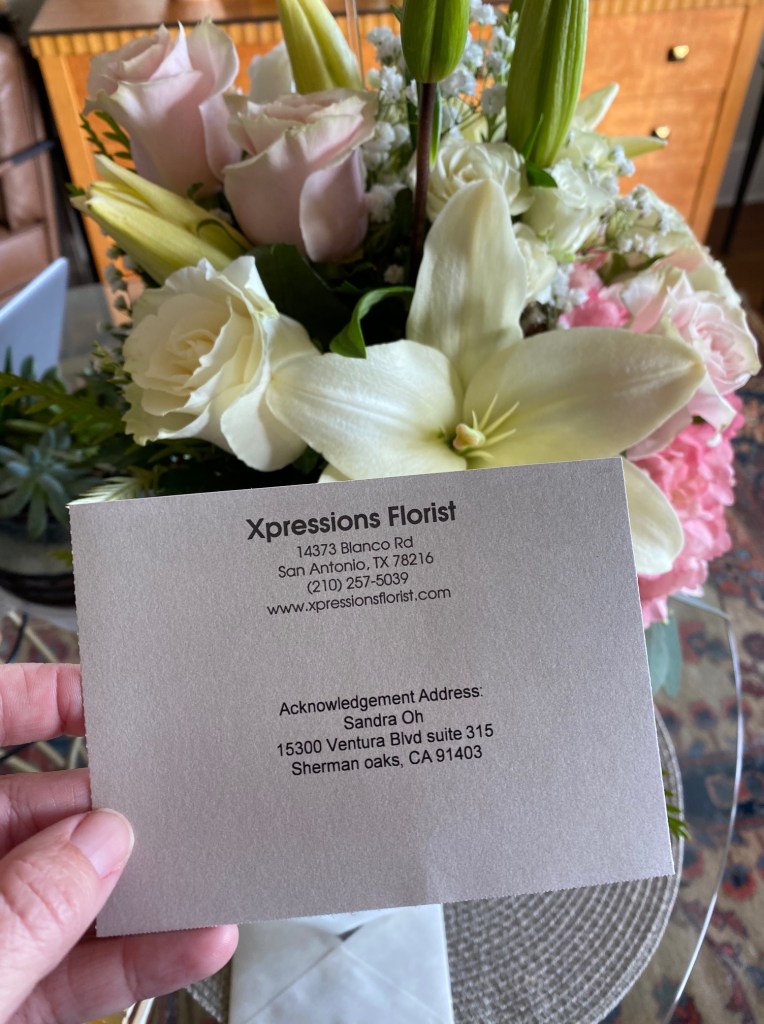
- Send the flowers. This is a debatable point, as some people feel flowers and plants end up being one more thing to manage during a difficult time. But I fall on the side of sending something sweet, as you might a card or a note. The flowers pictured above were the first thing that greeted my after my father passed away in 2021. A friend in LA, whose partner is the icon actress Sandra Oh, sent them immediately after hearing news of Dad’s death and they really were a bright spot. It reminded me people cared — and knew. Sometimes flowers can do that, so I say send them.
- And if you feel you want to order flowers for the funeral, that’s nice, too…but sleuth it out first. Find out through the funeral home (NOT the griever or their family or close friends for the love!!!!) who is providing flowers for the service and add to the spread. Our aunt did that for us when our dad died and it was really nice. All the flowers at the church matched and that scratched my OCD itch for matchy matchy.
- Sign up for any group support or activity for the bereaved. Whether it’s a meal train or a Go Fund Me or a prayer chain or an outing or a whatever, make sure you’re a part of it.
- Get comfortable with saying the deceased loved one’s name, asking gentle questions about their loved ones and what kind of person they were and boldly recalling personal reflections. Tell them how their loved one inspired you and how you will live out their strengths. This may seem awkward or hard or too sad. But it is life-giving to a griever to keep their person’s name and memory in the present.
- Show up. Be there. Not with a purpose, but with presence and and peace. Just be on the scene and leave any agenda at the door.
- Listen. And listen some more. Calm your bod and stuff a sock in your pie hole. Listening is everything.
- Say, this sucks. Just wallow in the suckage with them.
- Share comfort with physical touch — a long hug, a back rub, a hand hold, a squeeze. Letting the griever know you are ready to “be there” and be present by giving them a loving, tangible sign is so important.
- Sit and be still. Nothing says “you’re not alone” than someone just quietly being on the scene.
- Swing by and whisk away. This may take some old fashioned intuition and good luck. But when it’s the perfect time, a friend who’s in the car waiting to zip you away for some frozen yogurt or a cold beer or a Starbucks coffee may be just the ticket. A friend and I were recounting how our mutual buddy came to her house after her mom’s passing during high school. He rang the doorbell during a particularly dicey family disagreement and asked whether she’d like to grab some TCBY yogurt. What good fortune! It was the perfect time to slip away and catch a break from the post-funeral yuck. Sometimes swinging by and whisking away is like a Coke — it’s it!
- Help with the stuff purge if you’re close to the scene. After Mom died, her best friend swooped in and cleared out her closet. She knew that would be too hard for my dad to handle and she was right. Not everyone can do this job.
- Finish the unfinished business. The same friend of my mother’s completed a quilt for me she’d been working on before she died. Maybe there’s a project or two you can wrap up for the griever. This is a special, most meaningful task.
I’m sure I’m missing lots of good ideas from this list. I would love to hear yours! Share in the comments what acts of kindness and support you’ve appreciated most during your grieving — and what was totally annoying.
 Grand Plans
Leave a comment