
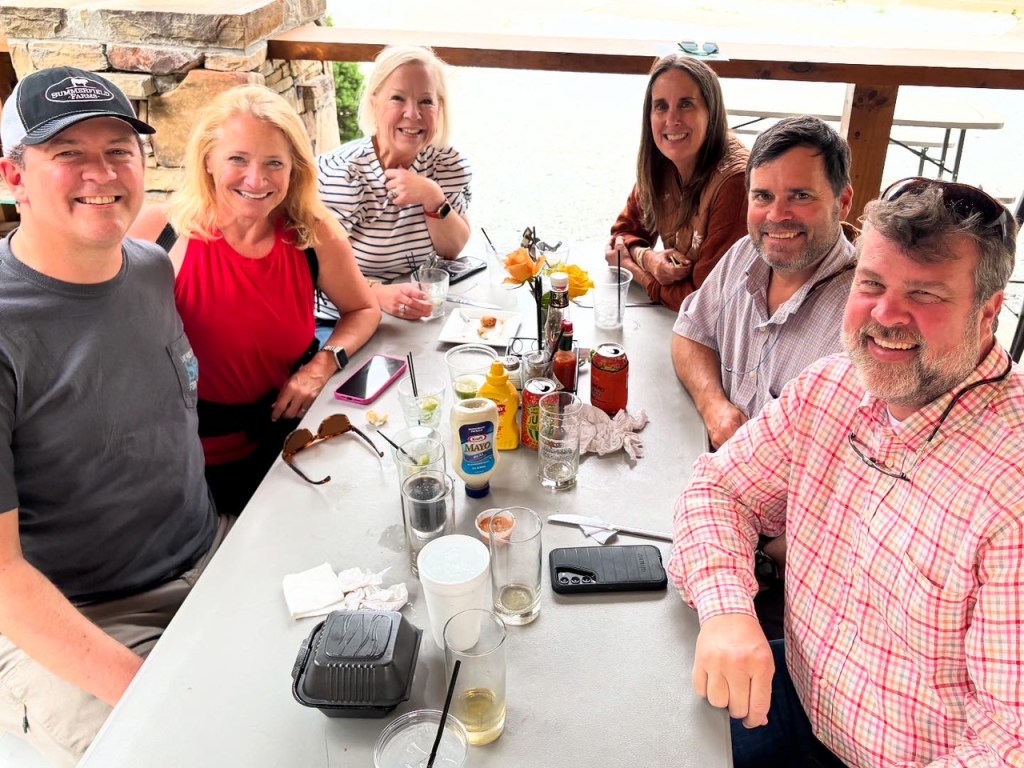
This summer, David and I spent a few weeks in Lake Toxaway, NC for his sabbatical and it was nothing short of relaxing and reflective. Plus, some longtime friends came for a visit and we spent hours hashing through our shared station in life — that chunk of adulthood when we’re all navigating older parent business and death and all the funnies and hairpulling associated. Of course, the number one requested song from this playlist is a headbanger called “Oh My GOD. The Stuff.” It’s everyone’s most played but least enjoyed tune. The refrain? “I’m stuffed. I’m stuffed. Please, Lord, no more stuff.”
Our happy little band of college merrymakers is just a small, small percentage of the millions of other people experiencing our very same kvetching. I dare say, most adults over the age of 25 are feeling the same feels: Earth to parents — we don’t want your stuff.
An overabundance of stuff creates headaches for everyone, especially younger loved ones who are sent in to pick up the pieces when we’re gone. One of our friends explained how her mother-in-law had dutifully and conscientiously logged the history, value and data points of her fine antiques and trinkets before she died — a very helpful compilation of information that helped sort a few things out. But the stuff remained. And at the end of the day, our friends have THREE extra large storage rooms FULL of well-documented, highly cherished castoffs that no one has the space or desire to accommodate. Call it finery, splendor, collectors items, antiques or period pieces if you will, but there’s one universal term to describe it: somebody else’s junk.
We sighed and shrugged and drank over another phenomenon: our parents insistence on accumulating MORE stuff as they moved into their later years. Instead of paring back and purging and decluttering, some of our parents have pumped MORE MONEY into MORE STUFF, only adding to what is destined to be an even bigger collection of more stuff that in the end, no one has any interest in salvaging.
This is a problem, ya’ll! And not to say all stuff collections are evidence of hoarding. But mentally and physically valuing your stuff puts a person well on their way. While hoarding disorder affects about two percent of the general population, it gets worse when we age. Six percent of adults age 65 and older fall into the hoarding category. This suggests older adults are significantly more likely to resist decluttering, which can complicate household inheritance and clean-outs. In a study of self‑reported compulsive hoarders, symptom severity was shown to increase steadily as we age, from mild in young adulthood to progressive and chronic in late life. Older generations are significantly more prone to hoarding behaviors than younger counterparts, underscoring a trend of growing reluctance to declutter with age. And why is this a problem? As clutter behavior becomes more ingrained and severe over the decades, it becomes psychologically and logistically more difficult for adult children or caregivers to intervene. These patterns can result in emotional and practical burdens for adult children, who are likely FREAKING OUT over the managing or dispersing belongings, estates, or households.
But wait, there’s more reason to call our obsession with stuff a problem: Clutter in the homes of seniors contributes significantly to safety hazards — one in four adults over age 65, that’s 36 million Americans, fall each year. Why? Obstructed living spaces filled with possessions. Older adults with compulsive hoarding behaviors are 90 percent more likely to report chronic medical conditions, compared to just 44 percent of older adults who aren’t hoarding. Clutter in any form is associated with declines in physical health and caregiving challenges. Truth!
Plus…It’s just not worth it! When my brother and I went through our Dad’s beautiful estate in Holly Springs, MS, we discovered a large trove of period pieces and accoutrements — many of which we sold with the house. To be sure we weren’t throwing out the baby with the bathwater, we hired an auction professional to come in and take pieces she thought would be salable, or render some value, on the international auction market. While she took away a lovely assortment of items, the value from the auction wasn’t even enough to cover a family vacation.
So here’s the headline: You can love and enjoy your stuff, but do not ascribe value to any of it. And for Pete’s sake, love and enjoy it and purge it before it’s one more headache for your loved ones to remedy after you die. The person who dies with the most stuff does not win, they just create a losing proposition for any family or friend who has to reckon with it all.
We love getting together to celebrate our common aches and pains and challenges. But seriously, any more of this stuff obsession is going to drive us all to drink at an unhealthy level. On behalf of the college squad meeting in North Carolina this summer, I thank you in advance for addressing your stuff issues STAT!
 Grand Plans
Leave a comment