
It may seem super obvious, but I believe curiosity, honesty and open, ongoing conversation with loved ones are at the heart of designing a solid Grand Plan. No talk equals no action. You can entertain (or dismiss!) thoughts on aging preparation all day long, but they won’t get any traction until you start talking to others about them. Like my Uncle George reminds us when he quotes Albert Einstein, “Nothing happens until something moves.” That’s a sciency way of saying action is necessary for progress to occur, whether you’re talking about atomic bombs or planning your second half of life with intention.
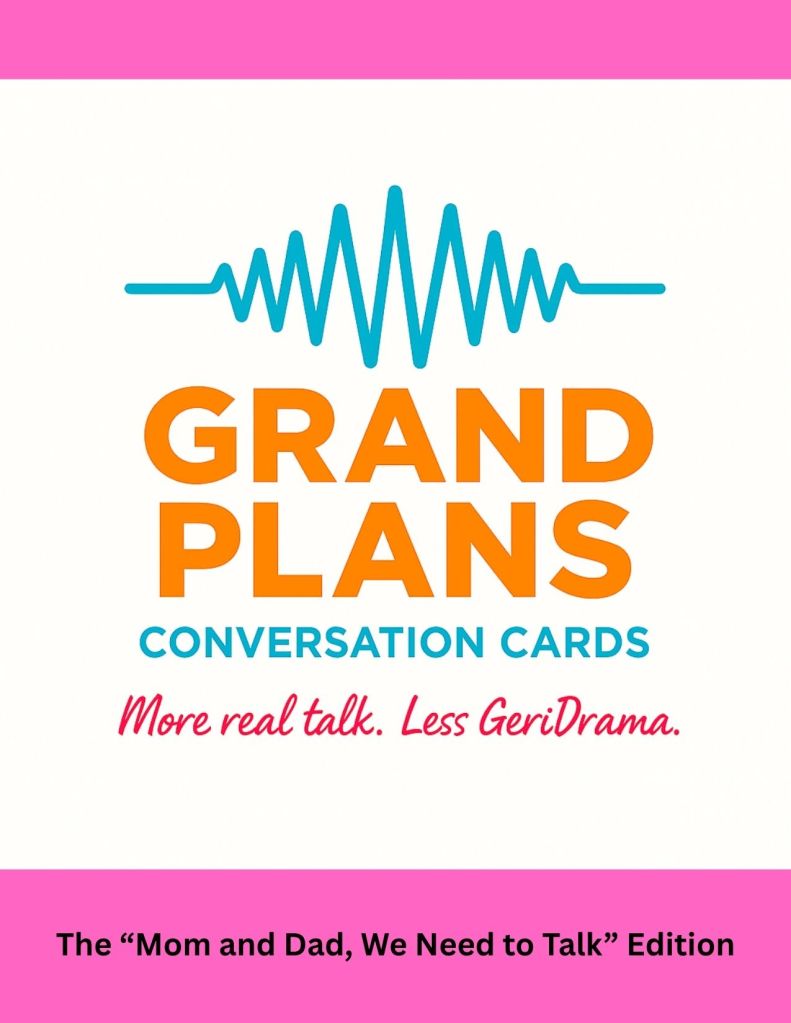
With that in mind, I am introducing a new line of Grand Plans resources called the Grand Plans Conversation Cards. There are four editions: one for adult children to use with parents, one for parents to use with adult children, another for friends and peers and another for professional colleagues and clients. Each set includes important prompts to generate real talk about preparing for aging. The goal? To normalize conversations about our second half planning and get things moving — in the right direction! These cards are currently in production and I aim to release them through the St. John’s Cathedral Bookstore and Gift Shop and other online venues this spring.
Until then, let’s talk about the why behind healthy conversations about aging. Why can’t we just let all this stuff simmer in our own dam brains, in private, without an annoying audience of naysayers noodling our plans? Why can’t we just let our own selves be?
The short answer? It’s selfish and destructive for relationships, our one day caregivers and the people we love most. Refusing to discuss our plans openly creates monster headaches and can absolutely decimate the legacies we may be working hard to cultivate. Not talking about it is ruinous, plain and simple.
As we age, 70 percent of us will need some kind of long term care support. 70 percent! That’s MOST of us. So, the thought that we can do all this aging stuff on our own without involving others is statistically unlikely.
Here are a few data-driven reasons why real talking about Grand Planning is important:
Most people agree these conversations matter, but very few actually have them.
National surveys show that 9 in 10 adults (≈90–92 percent) say conversations about aging, end-of-life wishes, and care preferences are important, yet only about 1 in 3 (≈27–32 percent) have actually discussed them with loved ones (The Conversation Project). What we avoid talking about doesn’t disappear, it just sits around and waits for more stress to build up around it.
When plans aren’t discussed early, decisions shift to crisis mode.
Caregiving research shows that the majority of long-term care decisions are made during or immediately after a health event, not through proactive planning—leaving families scrambling under stress (National Alliance for Caregiving). Silence doesn’t preserve control; it hands it over later.
Unspoken expectations significantly increase caregiver stress.
According to national caregiver surveys, more than one-third of caregivers (≈36–40 percent) report high emotional stress, and stress levels are markedly higher when preferences were never discussed in advance (AARP). Conversation is a preventive mental-health strategy, for everyone involved.
Social connection and communication are linked to better health outcomes.
Large meta-analyses cited by public health researchers show that people with strong social relationships have a roughly 50 percent greater likelihood of survival over time compared to those who are socially isolated (American Psychological Association). Processing life transitions out loud is biologically protective.
Shared decision-making increases the likelihood wishes are honored.
Health-services research finds that patients who engage in shared decision-making and discuss preferences in advance are significantly more likely to receive care aligned with their values and goals, particularly in later life (Agency for Healthcare Research and Quality). Autonomy grows when it’s articulated.
Avoidance raises stress even when people think they’re “handling it.”
NIH-supported studies link avoidance of emotionally difficult topics to higher physiological stress responses over time, even when individuals report feeling fine day-to-day (National Institutes of Health). Talking reduces cognitive load while silence quietly compounds it.
Talking about aging isn’t something to avoid or stay quiet about, it should be natural and ongoing and productive. And also to add here, there’s no one right way to do anything! Mindful aging discussions show us every person deals with financial, social, legal and physical completely unique to their very personal situation. There is no one size fits all, in fact, no outcome or discussion will be the same! So no reason to get competitive or copycat someone else’s strategy or try to apply a perceived “right” way to your particular life. You do you, but do you with others through healthy conversations and good listening.
Ready to start talking now? Can’t wait for the cards’ release? Here are a few questions to get things moving, as Einstein suggests:
When you imagine the next 10–20 years of your life, what feels most important to protect—your independence, your relationships, your comfort, or your sense of purpose?
If life surprised you with a health change, who would you want involved in decisions—and what would you want them to understand about your values first?
What does “aging well” actually mean to you—not in theory, but in daily life?
Are there aspects of aging or future care that worry you but that you’ve never really said out loud?
If staying in your current home became harder, what would matter most about your next living situation?
What kind of help would feel supportive to you—and what kind would feel intrusive?
How do you want your loved ones to feel if they ever need to step in and help you?
What conversations do you wish your parents or grandparents had had with you earlier?
If we had to make decisions quickly someday, what would you most want us to know about what matters to you?
What would it look like for us to revisit these conversations regularly—so nothing feels rushed or overwhelming later?
These questions aren’t about solving everything at once. They’re about opening the door, building shared understanding and making sure no one is left guessing when clarity matters most. Hopefully these Grand Plans Conversation Cards can help you and your loved ones engage in more productive mindful aging talk in the New Year. Cheers to that!
 Grand Plans
Leave a comment