
Part 1: Asking the Question
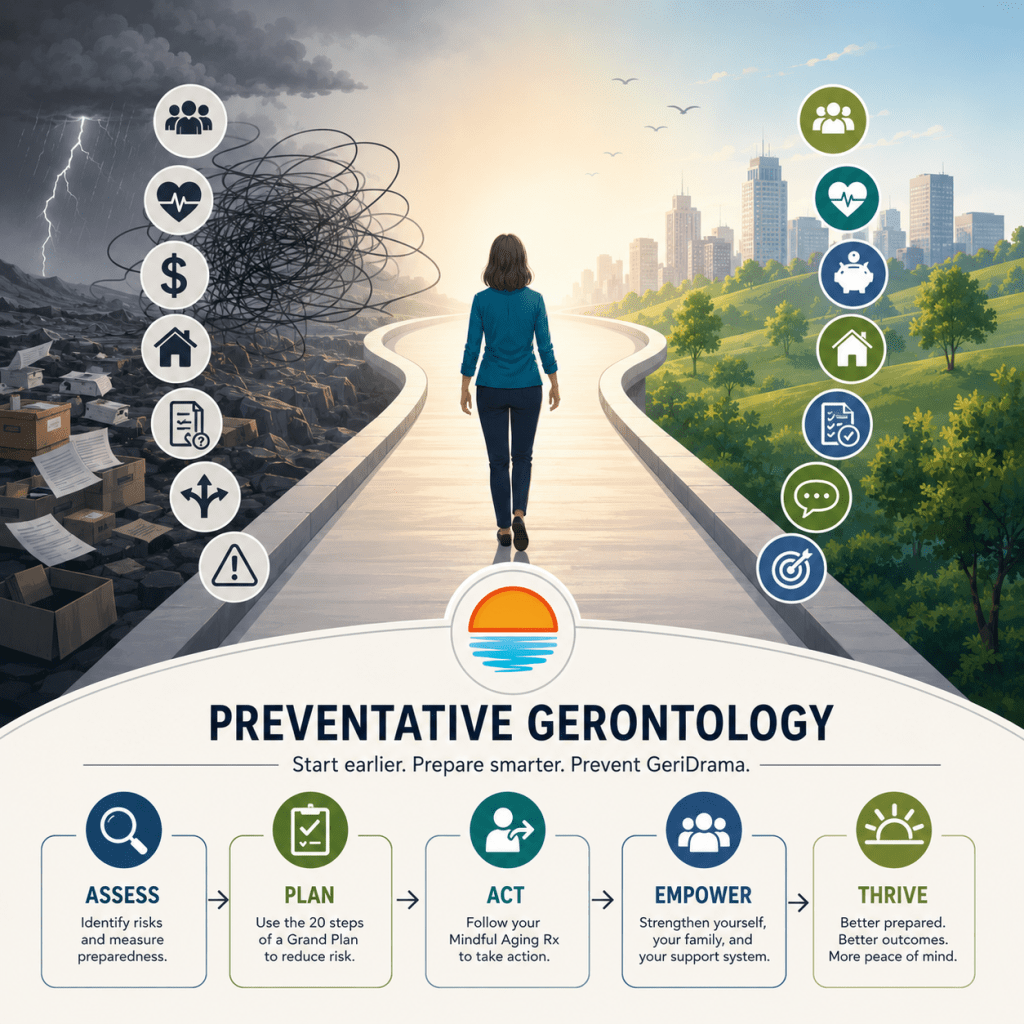
One of the most valuable lessons I learned while earning my master’s degree in gerontology was the importance of frameworks. In science, a framework organizes knowledge, helps explain relationships, and provides a structure for studying complex issues and designing practical solutions. It gives researchers and practitioners a common way to think about a problem and test approaches for addressing it.
During the past year, I’ve been thinking a lot about the now whats and the what’s nexts and I keep coming back to a new way of thinking about my practice. What if some of the things I’ve been yammering on about are actually a useful scientific approach? What if I’m on to something here? Could I, a non sciencey person with some good intel and experience, be ushering in some new thinking on the matter of grand planning? More succinctly…
Could preventative gerontology become a framework?
Our population is aging rapidly, yet much of our time, money, and energy is devoted to responding to crises after they occur. Families often find themselves making legal, financial, housing, healthcare, and caregiving decisions under tremendous pressure. While some challenges are unavoidable, many could be softened through earlier planning, education, and conversation.
That possibility has led me to wonder whether preventative gerontology could provide an organizing structure for helping people prepare for aging with greater intention.
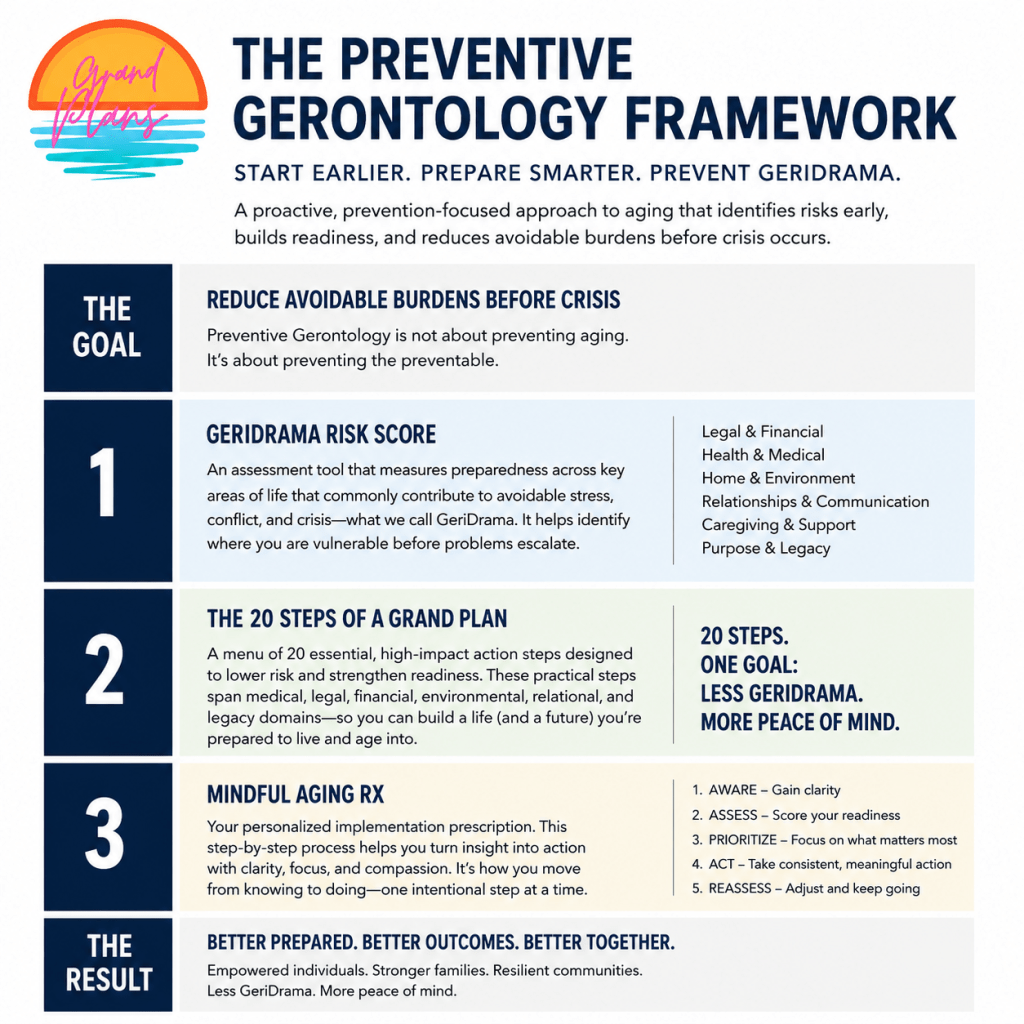
As I’ve developed the Grand Plans body of work, three distinct components have emerged that seem to work together.
The GeriDrama Risk Score serves as the assessment component. Its purpose is to identify vulnerabilities and planning gaps before they become emergencies. Like many assessment tools used in healthcare and public health, it offers a way to measure risk and encourage earlier action.
Grand Plans serves as the intervention. It provides practical, evidence-informed strategies that help individuals and families reduce those risks through thoughtful planning, communication, education, and preparation across multiple domains of aging.
The Mindful Aging Rx serves as the implementation strategy. Awareness alone rarely changes behavior. The prescription provides a simple pathway for translating insight into action, helping people prioritize next steps and begin meaningful conversations that often get postponed.
Viewed together, these three pieces raise an intriguing possibility. Assessment. Intervention. Implementation. Could they represent the foundational components of a Preventative Gerontology Framework?
I don’t know the answer, and I’m not suggesting the idea is complete. I’m sharing it because I believe many meaningful advances begin with thoughtful questions, collaborative thinking, and a willingness to explore new models.
I’d love to hear from fellow gerontologists, researchers, healthcare professionals, policymakers, caregivers, and anyone passionate about improving how we age.
Does this framework resonate with you? What would you add? What research should inform it? Where do you see strengths, gaps, or opportunities?
In future posts, I’d like to explore these questions more deeply, examine how existing gerontological theories and public health models might inform this concept, and invite others into the conversation.
Perhaps Preventative Gerontology is simply an interesting idea. Or perhaps it has the potential to become a useful framework that helps more people age with preparation, purpose, and greater peace of mind.
The conversation has to start somewhere. I hope this is one place it begins.
Learn more and explore the free GeriDrama Risk Score at www.mygrandplans.com.


Leave a Reply