

Dang, the aging services ecosystem has been en fuego since Saturday Night Live televised its painfully accurate, funny not funny, lord mercy, on point sketch aptly called, “Sister.” If you haven’t seen it, you are either on an island with no interwebs or have not yet fallen into one of Rosalyn Carter’s famous four buckets — “caregivers, those who are caregivers, those who will be caregivers and those who will need caregivers.”
The social feeds are literally blowing up about it, and this skit very well may be the mysterious cause of all the weird outages and groundings and fritzes we’ve been experiencing since last Saturday, not really of course — but the response is really shaking things up among the 1 in 4 Americans who are caregivers!
If you’re still like, huh?, here’s what you missed:
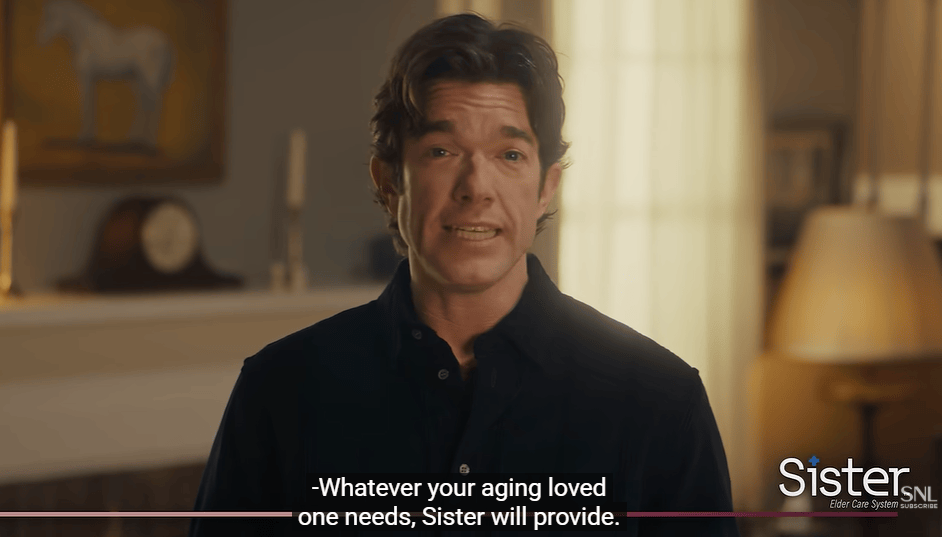
“Sister” is a fake commercial for an eldercare service whose big selling point is that it’s free—because it’s your sister doing all the work. It aired November 14 with host John Mulaney and Jane Wickline. The men praise their caregiving solution while the sister handles the responsibilities and sacrifices that allow their lives to continue largely uninterrupted.
The joke becomes increasingly uncomfortable: the brothers recognize that caring for their parents would overwhelm them, yet seem remarkably incurious about what it’s costing her. Medication management, hands-on help and the constant responsibility become someone else’s problem.
It’s striking a major nerve for good reason:
- Caregivers recognize their own families. Responses include laughter, anger and relief at seeing an exhausting, often unacknowledged role depicted so plainly.
- It exposes the assumption that daughters will take charge. AARP’s coverage connects the sketch to research showing that three in five family caregivers are women.
- It makes the hidden costs visible. The “free” service depends on a woman giving up time, work opportunities and parts of her own life. The commercial format makes that entitlement especially stark.
- It raises an uncomfortable family question: Have we actually agreed on a caregiving plan, or have we simply assumed one person will handle it?
Here it is for your watching cringe:
I watched it Sunday morning and couldn’t stifle my pillowside chortling. That there was some funny material, and of course John Mulaney is a freaking pro when it comes to good dead pan humor. He did not disappoint in his role as “Brother.” The whole thing was rich: highlighting the self-absorbed brothers, bitter father, tired subservient sister and even the unsuspecting brother-in-law who also has been drawn into the caregiving theatrics, a “freebie” as the fake commercial describes. Ha, ha. Ouch.
Then, like most people, I realized this really wasn’t funny at all. Every person to whom I considered texting a link wasn’t a worthy recipient, it felt…mean, to send it. The first person I thought of was my amazing, organized sister-in-law who managed the care for her father, and though she did so with willing support from her brothers, sending her the video link seemed inconsiderate at best — at worst, a reminder that she, like most “Sisters,” are the ones whose lives are changed by caregiving responsibilities.
Data from AARP and the National Alliance for Caregiving’s Caregiving in the US 2025 bears this out:
- Their own health can get pushed aside. 26% of women caregivers—about one in four—say caregiving makes it difficult to care for their own health.
- About 38 million women are family caregivers. Women represent 61% of America’s 63 million caregivers—roughly three in five. The 38 million figure is calculated from those national estimates. aarp.org
- Nearly three in ten American women provide care. In 2025, 29% of women were family caregivers, up from 21% in 2015. aarp.org
- Women more often carry a workload equivalent to a full-time job. Among caregivers of adults, 26.5% of women provide at least 41 hours of care weekly, compared with 20.8% of men. Caregiving in the US
- Women report more emotional stress. 41% of women caregivers report caregiving as emotionally stressful, compared with 33% of men. caregivingintheus.org
- Women experience more physical strain. 21% of women caregivers report physical strain, compared with 16% of men. caregivingintheus.org
- Women are more likely to feel alone. 26% of women caregivers report feeling alone, compared with 20% of men. Caregiving in the US
- Women do more intimate personal care. Among caregivers of adults, women more often assist with bathing: 34% versus 27% of men; dressing: 38% versus 30%; and incontinence management: 24% versus 20%. Caregiving in the US
- Women more often perform medical and nursing tasks. 58% of women caregivers of adults handle tasks such as injections or catheter management, compared with 51% of men. Caregiving in the US
- Women shoulder more of the coordination and advocacy. Among caregivers of adults, 67% of women communicate with health care providers, compared with 60% of men; 61% advocate on the recipient’s behalf, compared with 54% of men. Caregiving in the US
- Women report greater financial strain. 19% of women caregivers report financial strain from caregiving, compared with 16% of men. caregivingintheus.org
Of course, this isn’t every caregivers’ story. No two situations are the same and everyone has different strengths to bring to the family caregiving story. In my case, my brother was the one managing all the “after” of our father’s unexpected passing and prior to that, as the person living closest to our dad, my brother was more on-call than I was living in Florida hundreds of miles away. When I was remote caregiving for a deceased friend’s parents, I was not doing any of the heavy lifting on the daily, but instead put up paid care scaffolding around them. Still, there was ample stress and worry to make my hair thin and my chardonnay glass perpetually full.
I guess the lesson here is that we’re all the butt of the joke in “Sister.” As Rosalyn Carter said above, we’re all caregivers or care-receivers one day. And 1 in four of us already are. So until the rules of society, culture and government change and the caregiving landscape becomes smoother and more attainable, the onis is on all of us to be merciful and humble and grateful toward the 64 million caregivers among who us do this hard work and to GET PREPARED. If there ever was a call to get your Grand Planning buttoned up, this is it. We don’t have to pass on a legacy of “Sister” to our kids and grandkids. We can start today by lightening the load for them and thinking mindfully about the aging and caregiving that we are bound to encounter should we be so fortunate to live another day.


Leave a Reply